Lenormand's Core Confusion
Putting on some blinkers

I ordered now OOP The Burning Serpent Lenormand during a long break from divination. The fact that this was a book and deck set from Rachel Pollock means that I backed it on Indiegogo and then forgot about it until it turned up in July 2014. This means it has been nine years since my Lenormand journey began, and sometimes it feels like I still have a long way to go!
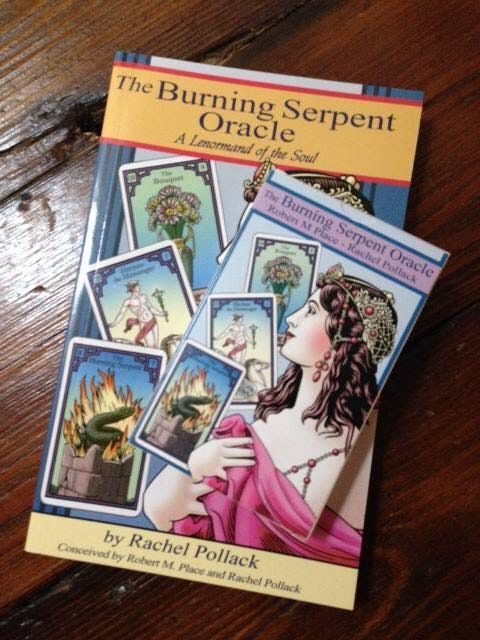
Rachel says in the book;
“In creating The Burning Serpent Oracle, Robert and I followed a clear directive. First, we wanted a set of cards that worked as Lenormand. Secondly, we wanted each card to contain something ‘extra.’ That something could be as simple as the moth of the card 36. the Rusty Cross. or as daring as the Muse rising above the Clouds on card 6.
Do these extra elements open the way to completely personal interpretations? Of course, anyone who wishes can read any set of oracle cards that way, including most traditional Lenormand. But that was not our intent for The Burning Serpent. the added or altered images all have their own distinct voices.”
She goes on to describe how the meanings in the book have four levels:
the simplest, most direct meaning
the basic meaning expanded, explored
a larger context that allows us to mean to understand what this idea can mean in our lives
a “secret” or sometimes mystical meaning that lets us understand it in a different way
Was it the right place to start?
You only have to read her ‘basic meaning expanded, explored’ paragraphs to understand that she gets the Lenormand system with its acquired quirks (like the sides of a card having different impacts due to the way the card was illustrated) and its inbuilt ones (the near and far method).
Comparing the ‘the simplest, most direct meaning’ in The Burning Serpent against Dan M. Pelletier’s direct and concise meanings in his La Santa Muerte Lenormand guidebook align pretty well.
I’m sure there will be more than one person who could tell me that making an Oracle from the Lenormand system is wrong. And I would agree with them if I felt that this deck was why I have wobbles with the Lenormand system.
These wobbles centre around me, struggling with certain cards in the context of the reading due to so many conflicting meanings and getting confused, not because one fabulous creator ‘added extras’ to their version of Lenormand.
Theoretically, there is a ‘right’ way and a ‘wrong’ way to read cards using the Lenormand system.
The ‘right’ way includes adherence to the ‘Philippe Lenormand’ Instructions (PLI). The PLI was first published in German in 1846. I am struggling to find out its first English translation. I think Madam Morrow’s Fortune Telling Cards as described by Mary K. Greer in her 19th Century American Lenormand Decks blog post:
The first edition, mentioned in the Uniform Trade List of July 1867 as Madam Morrow’s Fortune Telling Cards, was an exact replica of the German Kunst-Comptoir, Berlin deck of 1854…
The booklet is only in English, but it is an exact translation of the standard German instruction sheet.
The image below is the PLI printed in The Evening Worlds Home Magazine in 1903.
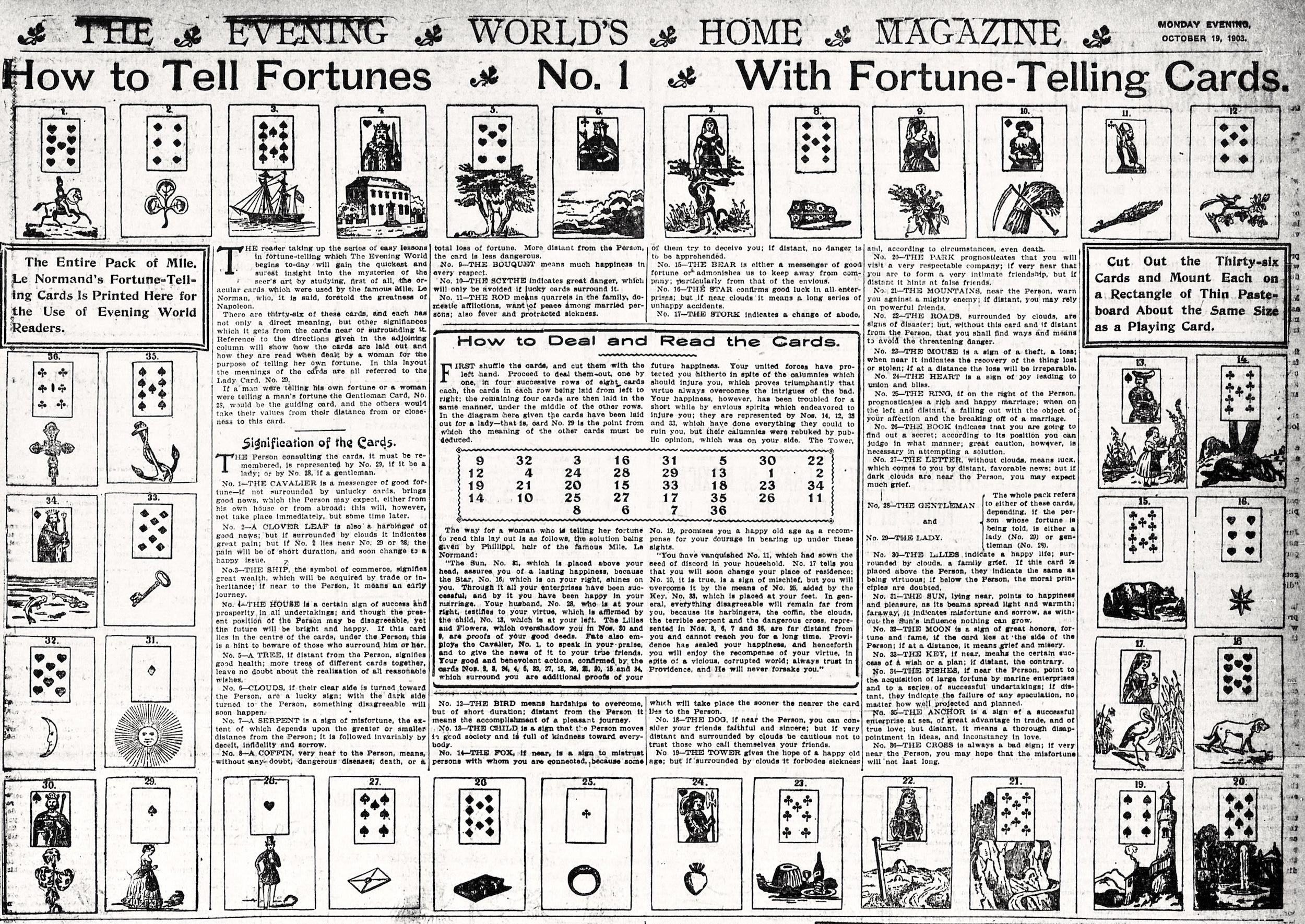
There is a lot of overlap between the PLI and what we might consider ‘traditional’ modern meanings (as embodied by authors like Björn Meuris and Andy Boroveshengra), but there is some divergence too.
Let’s take Anchor as an example:
No. 35. — THE ANCHOR is a sign of a successful enterprise at sea, of great advantage in trade, and of true love; but distant, it means a thorough disappointment in ideas and inconstancy in love.
In the first volume of his book, Björn provides the keywords: Hope, Stability, Grip and Safety. And Andy suggests Hope, Foundation and Stable. Neither is focused on successful enterprise at sea (which we might now say is Ship + Anchor). But the modern (and more progressive) meanings make sense when we consider what an anchor’s function is and what the original Game of Hope instructions describe it as:
35. Anchor– setting port, staying put, stable, security, hard work, may mean near the ocean. Can potentially lift the anchor in the future.
So far, so good, but the wider divergence still causes me some mental gymnastics because the more authors you read, the more you have to ‘decide’ what you want the card’s meaning to be at that moment.
Rachel acknowledges working through a lot of them in the acknowledgements of her book:
The meanings and explanations for the cards draw from many sources. To learn the traditional way of viewing each card, I consulted ten different interpretations for each one, going back to the earliest sources and continuing to the present day. I am particularly indebted to the wide-ranging cultural approaches of the German writer, Harald Joesten.
I stated earlier, that I started studying in 2014 when ‘schools’ of Lenormand were still a ‘thing’, but I wish they’d called them ‘variations’ or just ‘modernised’ or, in some cases, ’ personal spins’ - lumping them into ‘French’ or ‘German’ schools messed up the fact that different authors had different takes and depending on who you read your reading style was influenced by them.
In July 2016, I was still working on clarifying what I thought was my ‘essences’ or core meanings of the cards, and I came up with these? Why did nobody stop me!!!
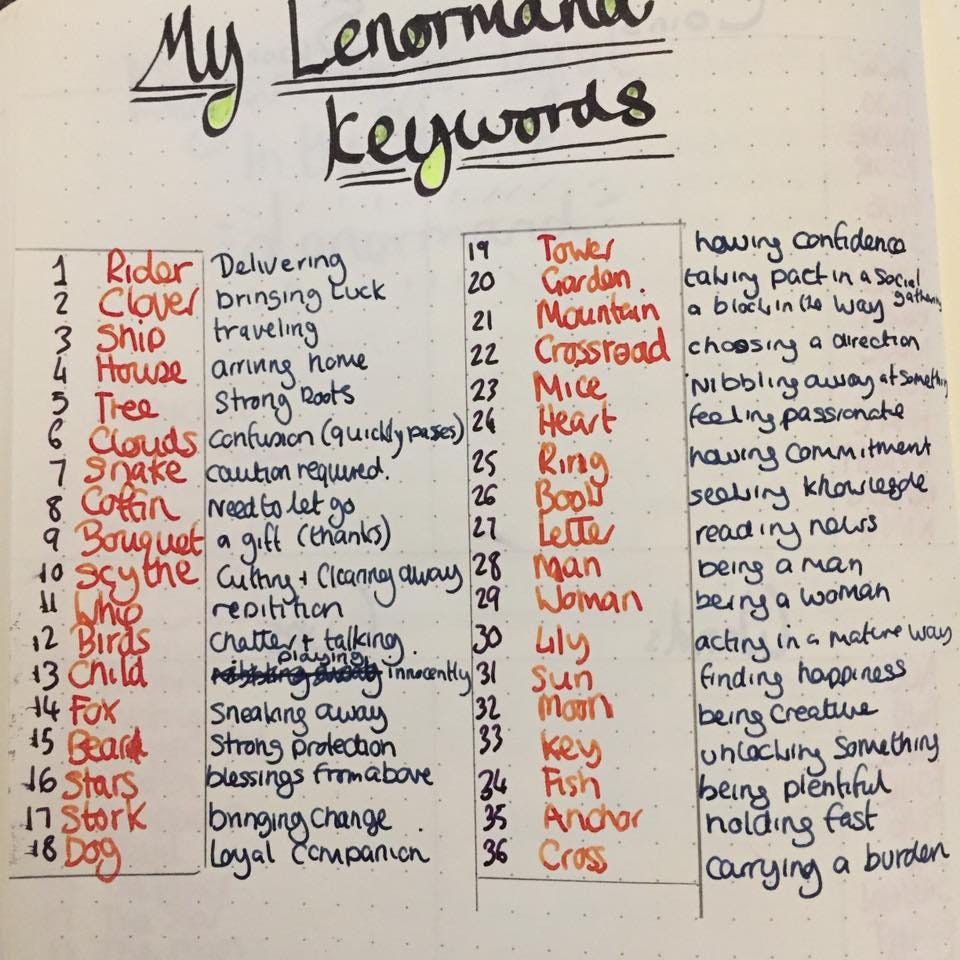
They aren’t all ‘wrong’, but are they helpful? Not really. And why don’t people make it clear that when they say choose 2 or 3 core meanings, they really mean to choose one or two core meanings from the same source!!
If I’d done that, stuck to Rachel’s simplest, most direct meaning[s], for example, then maybe I would not have come up with the list above.
But my brain wants to examine as much information as possible, compare sources, etc. and then try to make sense of things from there.
Not a good tactic when tackling Lenormand.
Now, in 2023, I’m taking an extended deep dive into my Lenormand practice - by taking some repeated advice from Stella (https://fatekeepson.blogspot.com) - and sticking to two sources Lenormand Thirty Six Cards by Andy Boroveshengra and supplementing it with the Petit Lenormand Encyclopedia Volume 2 by Björn Meuris.
I aim to clear away the clouds and get anchored again, not only in meanings but in core techniques, and finally tackle the Method of Distance.
I may deviate in terms of techniques (for example, I have my way of navigating a GT and a box spread), but in terms of core meanings, clusters, and card interactions, my goal is to see how far I can get by putting on some blinkers and limiting my choices.